Showing posts with label collage. Show all posts

Friday, October 14, 2011

8 Women's Visions and 1 Woman's Details

Dialogue with Red, ©2011, H. Hunter, 29" x 29"
As the Jewish New Year passed last week with all the speed of a French TGV train,  I spent ellipses of that time "wondering" my way back over the year. And I do mean wondering.

This past year,  my goal was to create work for an art quilt show I'd been invited to participate in. Never mind the fact that prior to this, I had done very little quilting, when I dive into something, I'm passionate about it. I try to inhale as much knowledge as I can, trusting that if I do, it will carry me to a place that I can equally trust.

In the spirit of that quest, I gave myself  the challenge of creating six 36" quilts in the space of six months. I liked the multiple of six and I thought that the time I'd allotted would be more than adequate. For traditional quilt patterns, this would be ample time, but because I was approaching quilting like collage, the time passed in the blink of an eye. 

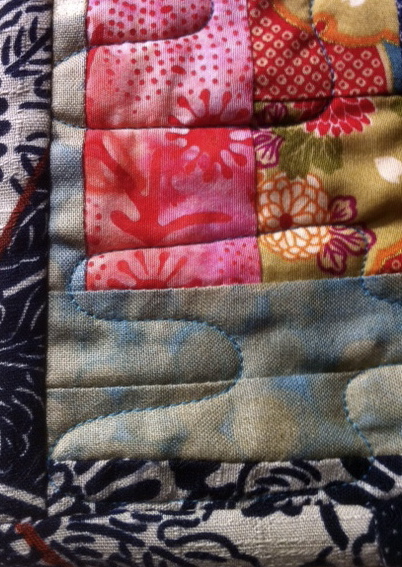
Junebug, detail, ©2011, H. Hunter, 27" x 27"
That's how the other week I came to find myself with six quilts, all needing to be bound and sleeves for hanging added as well. In some ways this might seem like the easy part of the process: choose a binding and off you go. But instead, using the collage process (cut out that piece, put it in, see if it fits, take it out, try another place, moving it until it fits and so on), it turns out that the binding is an integral part of the piece, and is much more than a quick intuitive decision.

After cutting the first round of bindings, I began to attach them and found myself making faces. "Yuck! What's going on here?" I asked myself. As I unstitched bindings and studied the quilts, I discovered that actually, the binding seemed to serve the same function as the final strokes of a drawing.

I also understood that I was facing my one of my own oft repeated laws of art: whenever I begin a painting, a drawing, or a collage, the choices are limitless, or, limited only by my own personality and imagination. With each step, the choices narrow because of the actions already chosen. When I get down to these last strokes--the challenge is to be concise, to choose the exact combination of colors that will allow my format to sing like Isaac Stern playing a Bach partita.
Quintessence, detail, ©2011 H. Hunter, 30" x 30"
At the same time, it's the place of greatest risk. If I make the wrong decision, I stand to lose everything.

Early the next morning I grabbed my dilemma by its horns and headed up to the studio in my nightgown (that way, the quilt is taken by surprise, it's not sure whether you're serious or not...)

I began to cut and sew. After an hour had past, I'd past the test and made it through the rough spots.

I'd taken a risk and allowed the work, not my head to tell me what kind of fabrics were needed. A revelation indeed because at the eleventh hour, I often want to depend on my head not my eyes or my heart.

A week has passed since I wrote this. The new bindings are now sewn on, the show is up and I'm just about ready to head out the door to the opening. And like the bindings, I've learned that even though I may want to shortcut the evening (the biggest challenge of the whole process is showing up for the event) I'm thinking that by completing the circle and taking a risk, I just might learn something that will help the evening to sing.

Friday, January 14, 2011

New Year Unfolding--Straw into Gold

Straw Into Gold, ©Hannah K. Hunter, 2011
The other day my sister Amelia and I spent our last morning of vacation exploring a small store in Kauai, which sold beautifully crafted jewelry and sarongs. Brilliant colors and patterns wafted in the temperate air, rivaling the nearby hibiscus. The store was called "Live a Little," ever a good motto for me.

We spoke with the owner, an enthusiastic and friendly man slightly younger than I. We exchanged first impressions of our home states and he told us a story of his first trip to the mainland in 1992.

He'd landed in L.A. during the Rodney King riots of 1992 and he described for us the empty freeways, the closed shopping plazas and the unsettling quiet.

I was both surprised by his candidness and embarrassed, hearing about this disturbing welcome to California. 
Later on that day we were wandering through a small town when we suddenly heard a man's voice yodeling and looked up to see the same store owner waving to us with the shaka sign, a common greeting gesture in surfer culture. Surf boards were strapped to the top of his car, which was headed for the beach.

When I looked up this greeting, I learned that in Hawai'i, it expresses a spirit of friendship and understanding between the many cultures living in proximity there--in other words, the spirit of aloha.
Hawaiian Highway sign
I did some more looking and found that "aloha" not only means hello and goodbye--but also refers to a means of  solving a problem, accomplishing a goal, or finding a meeting between mind and heart

This seems like a gentle and ease-filled way to go about meeting my goals; bringing together my mind and heart, finding my way to my Source.

That's what I'm striving for this year. All too often, 'Mind' heads off in the direction of her choosing and 'Heart' sticks around wondering "What just happened here?!?" Or, vice versa.

Surfboard Memorial for Andy Irons, 2010
The collage at the top of this post was made during my time away. I was thinking of the coming year and wanted to express my deep wish to spend as many hours as I can in the studio; making. I chose the hands of this older woman to signify the power that aging brings, the skillfulness brought to bear on materials and the absorption that is possible when you've given yourself over to your heart and mind's desire.

Wednesday, September 15, 2010

An assemblage of diverse elements

I've been thinking about what it means to create a collage; to take papers, cloth, diverse scraps from the mind's eye and bring them all together in order to create something new and heretofore undiscovered. In other words, to create new territory where there was none.

During this time, I've been listening to Divisidero, by Michael Ondaatje, in the studio and as I drive to work. The novel is a pastiche of exquisitely drawn characters, connected to each other in inextricable but mysterious ways. He uses the metaphor of collage to describe their connections:

"Everything is collage, even genetics. There is the hidden presence of others in us, even those we have known briefly. We contain them for the rest of our lives, at every border that we cross."

It makes sense to me, this notion. As I make my way across the collage I'm working on, I encounter shadows of several patients I've worked with,  a memory of filtered autumn light through studio windows and my earnest musing about appropriate titles. The name of a former piece echoes through several years, to me, this Virgo and I glue layer after layer of myself and my history onto a large and heavy panel. I listen to Ondaatje's words:

"Only the rereading counts, Nabokov said...For we live with those retrievals from childhood that coalesce and echo throughout our lives, the way shattered pieces of glass in a kaleidoscope reappear in new forms and are songlike in their refrains and rhymes, making up a single monologue. We live permanently in the occurrence of our own stories, whatever story we tell. "

What a pleasure it is to be back in the studio again, cutting and pasting cloth and words.

Wednesday, August 25, 2010

10 Things to Love at a Gallery

Object would Not Stand Still, detail, HKH ©2010
I was taken with this recent review of Lessons from Things in our newspaper, the Davis Enterprise and asked Melissa Hiatt, the author, if I could repost it for you to enjoy. It's not every art review that includes lines from William Blake together with a pancake spatula! I was grateful for her comment about my work, and, I think you'll get a kick out of the metaphors she uses to introduce the show.
I also included photographs of pieces I love, but were not included in the review.

By Melissa Hiatt
Enterprise art critic
August 19, 2010

The little things can really get under your skin: the gummed-up, crusted-over toothpaste that slowly oozed out of its hole in a desperate attempt to reach for its lid; the milk left out on the counter, which clearly establishes a horridly sour smell ... and the simple fact that another trip to the market will be necessary, in order to facilitate morning coffee and continued existence.

Underwater Drama, Marcia Cary ©2007
They say that we shouldn't sweat the small stuff.

I think they might be wrong.

Just who are 'they' anyway ... and what do they want?                  

Who would knowingly prescribe 'failure to pay attention' as a life philosophy? After all, a great deal of spiritual counseling advises noticing all things.

Entire practices can be devoted to the art of present observation.

Shell, Sara Post ©2010
And there's William Blake, and this passage from Auguries of
Innocence, which says it all:

To see the world in a grain of sand,
And heaven in a wild flower,
Hold infinity in the palm of your hand,
And eternity in an hour.

Everyday, ordinary things cannot only be transformative; they are, by their very nature, formative. The things we use daily offer cadence to our movements, rhythm to our methods.

Imagine flipping pancakes without a spatula.

Code, Tomas Post ©2010
While this last reflection might be received with a tone of triteness, rest assured, that isn't my intention. Pancakes are covetable and highly prized in our house.

Little things can become so much a part of our lives that we fail to notice their significance: whether they serve to annoy, dole out convenience, or provide the placebo of peace of mind.

Artist and curator Sara Post is determined that we stand up and take note. This month's Davis Art Center Tsao Gallery exhibit is filled with art centered on everyday things. Post's concept refers to a lost curriculum practice from French primary school, regarding the study of objects: their history, their evolution and their uses.

Dark Freesia 1, StaceyVetter ©2010
'Lessons from Things' houses the works of 16 artists who've approached both natural and manmade objects, and transformed their imagery into works of art through painting, collage, ceramic, printmaking, encaustic, fiber and mixed media.

According to Post, 'this exhibit offers an opportunity to slow down, to focus, to be with and perhaps to add to our understanding and enjoyment of objects that surround us.'

The participating artists are Chris Beer, Marcia Cary, Magdelena Crivelli, Barbara DeWein, Julie Haney, Hannah Hunter, Diana Jahns, Jose Moreno, Sondra Olson, Sara Post, Tom Post, Laura Reyes, Adele Shaw, Alison Smith, Stacey Vetter and Stacey White.

Sara Post is a nationally exhibited artist, and she shares a studio with her husband and fellow artist, Tom. While she has one piece in the show, 'Les Animaux d'Ivoire,' which bears her brush and hot wax signature of encaustic, she also shows three companion pieces that are a clear departure.

Jar, Sara Post ©2010
While her work of late has reflected lines fluidly carved out of deep layers of wax, she now brings the form of lines and edges to a flat surface with a collage of pencil, paint, wax and digital prints.

'Jar,' 'Umbrella' and 'Shell' depict these singular objects within a surreal environment and rest them ethereally, without the force of gravity. Their suspension creates both tension and intrigue. By removing the object from a traditional setting, the viewer is forced to consider
it solely on its own.

Jose Moreno's 'Bell' rings from his found object series. Moreno sees 'the object as a tool for expanding one's understanding of surface and light.' His tremendous skill shines through. Moreno's definitive realism
is imbued with a rich, warm light and tender sense of antiquity.

Coffee Container, Jose Moreno ©2010
His works are a singularly dramatic highlight. The juxtaposition of 'Coffee Container' with 'Praying Figurine' and 'Toy Dog' works seamlessly to inspire reverence for Moreno and his choices.

The list of things to love is long. Christopher Beer's pill-popping pieces are both witty and intriguing. Hannah Klaus Hunter's collages
consistently radiate a vitality and evolution that are intensely emotional. Julie Haney's 'Pie Spatulas' are a surprising favorite. Her choice of monotype led to an extraordinary representation, wherein the
purpose of the object fades completely when faced with its design.

The message is clear: It's time to consider the things we so often dismiss.

Lessons from Things, on view at the Tsao Gallery in the Davis Art Center through September 3rd.

Monday, August 2, 2010

Fresh Impressions: An Interview in 3 Parts

Lessons From Things, postcard front on the "fridge" gallery
I've been working on a series of still lifes for a group exhibit entitled "Lessons from Things" at the Davis Art Center, in Davis, CA, 
August 2 - September 3.


Last week I was approached by Lea Murillo, a reporter from our University paper The California Aggie. Lea asked me if she could interview me for the exhibit curated by Sara Post.

I embraced the invitation, knowing it was one of those opportunities that Alyson Stanfield, in her book, "I'd Rather Be in the Studio," recommends for those of us who prefer to hang out with our paint, paper and brushes rather than write about them.

I'm reprinting the questions and my replies in the next three posts, because most of the time, I don't get the chance to read what an artist has said as he or she said it--simply because another person, the journalist, is doing the writing.

Lea asked me to answer the questions according to how they apply to me, the exhibit, and the connection between the two. Hence the segue between myself and the exhibit.

 1.) How long have you been an artist and, what does your artistic background consist of?

I've thought of myself as an artist since the age of 21, 33 years ago now. I received a B.A. in Studio Art from the University of Iowa (where I spent most of my time in the weaving studio) and an M.F.A. in Textiles and Sculpture from the California College of the Arts (where I spent much of my time crossing the campus between the Textile and the Sculpture studios).

Tempting Fate, ©2004, multimedia
I've always been interested in the intersection between media so that in both undergraduate and graduate school, I focused on textiles, painting, writing and sculpture.

Throughout my career as an artist, I've tried to blur the lines between the disciplines, or, another way to say it is that I try to find the liminal zone where two or more media come together.


When Sara curates an exhibit at the Davis Art Center, she engages in a similar quest; she becomes interested in a particular area, such as collage, and offers artists an open range for exploration.

In the current exhibit, "Lessons from Things," the title immediately produces a cornucopia of ideas. According to Sara, the title "refers to what was once a part of the French primary school curriculum—the study of things or objects and how they came to be what they are—their history, their evolution, their uses. It is a way of looking deeply into an object and seeing what is there."

That same title takes me back to first grade when I learned that a noun is a person, place or thing. From there, I begin to think about how I want to document some "thing," which leads me to thinking about which "things" in my environment inspire me.

2.) What inspires you?

Baby pomegranate
I spend a lot of time studying the natural world around me: ripening fruits, flowering oleanders, rows of sunflowers, furrows of rice fields off the causeway. 

Oleander on the way to work
                  I also love to study patterns in architecture, quilts and words.
      

Dancing Ring, ©2009, quilt
                   I distill all of these observations into the form of a collage.

Twins, 1 ©2009, collage
I also draw inspiration from my work as an art therapist at the UC Davis Children's Hospital. Much of my recent work (although not in this exhibit) is a response to my involvement with various children and their effects on my life.

More to come tomorrow. I'll be posting about my experience of working on the still lifes. 

Saturday, July 24, 2010

A Code of Many Colors

Every so often, the worst thing imaginable happens. A woman's voice says in clear distinct tones: "Code Blue, Davis 7"

My heart skips a beat, waiting to hear the floor. "Please," I say inwardly, "not Davis 7."  That's our floor, the kids' floor.

Code blue is called when a person's heart stops beating. Doctors, nurses, a pharmacist and a respiratory therapist are paged to do their best to revive the patient.

From the point of view of the people involved, it's a team effort. From the point of view of an observer, it is an otherworldly event. When it is successful, the rest of the day is spent picking up the pieces, literally and figuratively.

A code blue took place on our floor recently and by great good fortune, the patient was revived.
In this instance, as an art therapist, my role is strictly that of the picker upper, one of many who helps put the pieces back together for a family. In this case that meant working with one of the child's siblings, a ten year old girl.

I looked into my internal Mary Poppins bag of tools. What to do? What project would allow this child to process the swirl of emotions taking place inside of her and yet preserve her dignity, her anonymity? 

I came up with the "Inside Outside" box. It's a standard art therapy directive, using collage materials; magazine pictures, Mod Podge, buttons, gems, pipecleaners, stickers, feathers, small wooden tiles (everything but the kitchen sink.)

We spread these materials on a table along with small boxes. The idea behind the project is that you put images on the outside of the box that express the part of yourself that you feel comfortable showing the world, and on the inside you place those images and objects which are private; images that represent the parts of yourself you might share with family or friends, or perhaps no one.

I watched amazed as this girl took the small tiles, carefully wrote the name of each of her family members and added a colored gem to each tile. She then glued them to two sides of the box and added some feathers on the opposite sides. It looked very ceremonial, like some kind of memorial marker.

Next, she turned her attention to the inside. I looked over as she was about to flick the contents of a brush heavily loaded with chartreuse green paint. "Whew!" I thought, "caught her before that went ALL OVER everything." Knowing she had a huge amount of emotion stored inside of her after the code, I taught her how to "point and flick." She spent the next half hour flicking every color of the acrylic palette into the box. I could not have imagined a more perfect way for her to express and capture her fear, helplessness and uncertainty.

That's the magic of art therapy. Behind a seemingly simple set of directions, lies an opportunity for a person's psyche in a pure, uninhibited yet protected way. (Provided these simple directions are supported by appropriate training in art therapy). It's one of those moments where all the study, hours of supervision, and my effort to keep faith in the process bears fruit.

Perhaps fruit isn't the right metaphor. I'm a Virgo, one of the most service oriented signs in the zodiac and I'm guided by the one of the tenets of my Jewish faith, "tikkun o'lam, " which means repairing the world. In a vulnerable moment like this one, peering into this small maelstrom of a box, I feel a piece of our world has been mended.

Pictured above is one of my first "Inside Outside" boxes made in 1999 during a class in medical art therapy.  I call it "My Father's Box."

Thursday, June 3, 2010

Striking a Balance/ Take 2

I was lying face down on a dock this morning, peering through the space between two weathered gray boards.  Water rippled beneath me and I could see the sepia colored sandy lake bottom.  A momma merganser and her flock strolled on the nearby beach.

Me? I found myself wondering once more about this elusive thing called balance. 

I'd arrived in northern Minnesota two days before to celebrate my in-law's 60 wedding anniversary. I'd worked up to the time of my flight, trying to bring closure to my upcoming exhibit, "Striking A Balance".

Before I left, I went over to my artist friend Linda's house with  several collages. "Are you crazy?" my sister Amelia said to me. You're leaving tomorrow and you've got to focus!" I pleaded temporary insanity and thought about the need for a good visual editor.

Over the years, I've developed a healthy respect for a judicious critic before a show; someone who loves your work and can tell you the truth about what's missing. It's a means of seeking balance, because in the process of exploring a new direction its easy to lose your way. I also wondered if I could use Linda's suggestions to tweak my own inner balance and find my way back to the center.

Linda took one look at the rice paper covered panels I'd made for mounting my collages and prescribed multiple, multicolored glazes. I mixed the washes and began brushing on layers of deep yellow, olive and sepia. After several hours, I was about to leave when Linda pointed to the collages I'd brought and stated definitively: "That one's finished, that one's finished, but that one's not."

"Oh my word!" I thought to myself. It isn't crazy enough that I'm trying to do this all today, but she's gone and found another fly in the ointment! It seemed that I wasn't going to find my elusive inner balance just then. Back home, I picked up a Diet Coke and headed upstairs to the studio.

Four hours and 10 matte medium covered fingers later, I emerged, satisfied with what I'd acheived.
I plopped down on my bed and riffled through "Sacred Therapy," a book I'm reading, and found this passage:

Healing into our wholeness involves learning how to gracefully navigate our lives between these opposite poles of yesh and ayin, form and emptiness.

Intuitively, those words sounded right at the time, but they didn't really make sense to me until today, on the dock. Stripped of my "doingness" in the studio, I'd discovered ayin, or emptiness, right here in the space between the weathered boards on the dock.

Wednesday, May 26, 2010

Striking a Balance Take 1

Someone asked me recently: "Why did you choose the name "Striking a Balance" for your exhibit?

Have you thought much about the balance in your own life? As I live my way through a day, I find myself at the nexus of many continuums: action/inaction, giving/receiving, cleaning up/making a mess, teaching and learning. I'm always in search of the balance, and like the see-saws of my childhood, I seek the miraculous middle.

Recently, I had the opportunity to work with a young woman of 20 who had been in treatment for cancer a good part of her life.  She was referred to me with the thought that I could offer her ways of expressing all of those inexpressible wishes that fill the heart and mind of one with such a diagnosis. When I receive a request like this one, I rely heavily upon the balance between my intuition and my years of training, trusting that both are there to support me.

An article I'd read in the latest Oprah on Vision Boards sprang to mind. I explained the concept to Sarah (not her real name), and talked about how to look for pictures that could paint a picture of her deepest desires. It was absolutely alright to hope.

As Martha Beck noted in her article " To really work, a vision board has to come not from your culture but from your primordial, nonsocial self - the genetically unique animal/angel that contains your innate preferences." I explained that by choosing images and creating a collage, her choices would impress themselves in her mind, helping to guide future choices.

She understood all this and quickly went to work. I scoured the pediatric floor, collecting magazines for her inspection. With the help of several volunteers her own age who supplied companionship, she created a board beyond my imagining.

Framed by a narrow border of leopard print which she had painstakingly drawn and painted, lived the images of a future life: a rose garden, a husband, her present and future family and the words "Love the Divine Life."

The board astonished many of us including her doctor. There is always a delicate balance in these rooms. Will the treatment work? Is it o.k. to talk about one's dreams?  How do you strike a balance between the turbulent voyage of treatment and the possible outcomes? How do you create value and meaning, when to the person in the hospital, their room seems to contain anything but that? This last question often means uncharted territory, but the board broke that wide open. For all of us who work with Sarah, the collage became a doorway into her soul. And, for that moment, she had helped all of us strike a balance.

Balanced Rocks Photo courtesy of: Michelle Meikeljohn, http://www.freedigitalphotos.net/images/view_photog.php?photogid=901
Photo of Red Rose courtesy of: Image: FreeDigitalPhotos.net

Thursday, April 22, 2010

Branding My Shoes

I decided to kick off the my week of "working for keeps" by taking a risk in my art therapy practice. Recently, I had the opportunity to work with a young patient of about 13. Her nurse came up to me in the hall and lightly catching me by the arm, said "Adelle wants to paint her tennis shoes."  "Shoes hmmm?" I always enjoy a challenge like this in the midst of hospital hustle and bustle.  "What would I need to paint some tennis shoes, Converse cotton canvas to be precise?" I thought fast.

I would need:
•some acrylic paint thinned slightly in a variety of colors
•2 (at least) emesis basins (those kidney shaped bowls that are standard hospital issue.)
•several toothbrushes. Raid the supply room.
•What to do about the floor? Grab a plastic isolation gown and some medical tape. Spread it out like a tarp, and tape the arms and bottom firmly to the linoleum floor.

Adelle and I hunkered down on the floor and I experimented with my flick and spray techniques. She didn't have much experience in this area, but caught on quickly, expertly flicking the first layer of yellow drops on her orange shoes. A shy tween, she was hesitant at first, especially because our activity attracted the interest of the residents and the nurses who came in and out of her room and couldn't resist asking the obvious "What are you doing?" She smiled and flicked her toothbrush, spraying flecks of yellow. I was impressed. The shoes were looking great and with an additional layer of red and cerulean blue, they appeared as if a professional had created them. Which got me to thinking. Most likely Adelle (not her real name) had a lot more experience with Internet shopping than I and more than likely, Converse was marketing just such a shoe. I went home and checked it out on my laptop. Sure enough, there was an option to "make" your own shoe". I spent a bit of time changing the colors and patterns on my virtual shoe, but in the end, concluded that doing it in the flesh was  better.  I searched around the house, looking for a pair of my daughter's old Converse tennies to spray. Too late, I remembered that they'd gone to Goodwill in a paper sack. What to do? The answer came to me this morning from my friend and coworker Janelle (her real name) while we were sitting together. She stared down at my worn Dansko clogs (standard hospital wear) and noted the multiple flecks of white paint on one of them. "You ought to collage those" she said "you know, create your own brand." "A beautifully painted pair of clogs", definitely a keeper of an idea. I'll be painting, collaging and posting. Care to join me anyone?

Sunday, March 7, 2010

Teaching A SoulCollage® Workshop

Someone recently asked me to teach a workshop on SoulCollage®. It had been some time since I've taught a class on this method designed by Seena Frost, a therapist in Santa Cruz, CA.  The process combines intuition and images and results in small 5" x 8" collage cards. Made over time, these cards accrue to become a deck of personal cards, which like playing cards, contain four different suits. Each card holds its own unique energy, particular to the person who made it.  Because the process bypasses the conscious mind, the meaning of the card imparts itself over time, much like a dream.

So it was this afternoon.  Five women gathered together to explore the Community suit; those people in our lives with whom we are in relationship whether intimately or from a distance. Images where laid out along a window shelf, stacked in boxes and hidden within piles and piles of magazines. Xacto knives and glues were at the ready and scissors waited patiently. "What would emerge" I wondered? I asked myself if I'd been able to convey the idea of letting the images "pick you," but SoulCollage® didn't disappoint. At the end of the afternoon, each women's card held the essence of an important and beloved person in their life.

My gratitude to Lynn Cohen who generously shared her pictures of the class with me.